
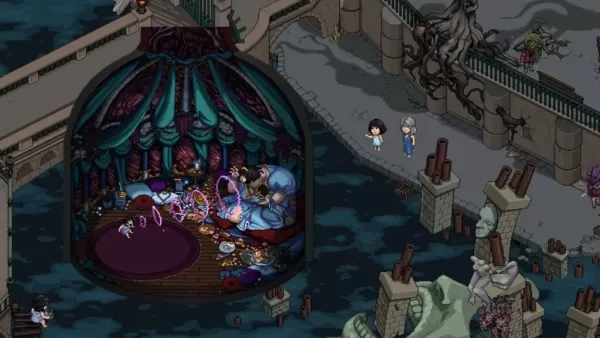
Decarnation is a hauntingly poetic psychological horror puzzle game that plunges players into the fractured psyche of Gloria, a once-bright cabaret dancer adrift in the emotional wreckage of her 1990s Paris life. At its core, the story is not about survival or escape — it’s about confrontation: the brutal, beautiful, and often unbearable act of facing the parts of yourself you’ve buried.
The Narrative Arc: A Descent into the Self
Gloria’s world crumbles after a series of personal and artistic failures. Her performances no longer move audiences. Her lovers have left. Her sense of self has dissolved into memory and regret. In this state of emotional collapse, she receives a cryptic invitation from a mysterious patron — someone who promises to resurrect her career, to restore her fame, to give her purpose again.
She accepts.
But the offer comes with a price: the path back to stardom leads not through the spotlight, but through the dark, shifting corridors of her own subconscious. What begins as a chance to reclaim her artistry quickly unravels into a surreal odyssey — a dreamlike descent through a theater that breathes, remembers, and judges.
As Gloria navigates this sentient, ever-changing stage, she encounters:
- Echoes of her past: fragmented memories of lovers, audiences, rehearsals, and failures.
- Distorted versions of herself: phantoms who dance with her, whisper her secrets, or scream in her voice.
- Living symbols of her trauma: a weeping mirror, a puppet theater that reenacts her deepest shames, a hallway that stretches infinitely with doors she’s too afraid to open.
Each puzzle isn’t just a test of logic — it’s a metaphor for healing. Solving them means acknowledging a truth she’s denied: that her pain is not a flaw, but a part of her story. That her fear of failure is not weakness, but the shadow of her passion.
Themes: Identity, Trauma, and the Price of Art
Decarnation doesn’t shy away from difficult emotional terrain. It explores:
- The duality of performance: the mask we wear to be seen versus the self we hide beneath.
- The illusion of reinvention: can you truly return to who you were — or are you doomed to become a version of yourself that never existed?
- The body as a site of memory and shame: Gloria’s dancer’s body becomes both instrument and prison, a vessel for beauty and pain.
The game draws heavy inspiration from:
- Satoshi Kon’s Perfect Blue: the blurring of identity, the terror of being watched, the fear of losing oneself to performance.
- David Lynch’s Mulholland Drive: dream logic, surreal imagery, and the uncanny sense that every scene holds a secret about the self.
- Existential and psychoanalytic thought: echoes of Jung, Lacan, and the myth of the shadow self.
The Monsters Are Not Enemies — They Are You
The most chilling aspect of Decarnation is that the "monsters" are never external threats. They are:
- The man who loved her but never saw her — a figure in a tattered coat, always just out of reach.
- The critic who still judges her in her sleep — a voice that echoes from the ceiling.
- The version of herself she left behind — a young girl in a sequined dress, dancing alone in an empty theater.
Defeating them isn’t about violence. It’s about recognition. You must face them, name them, and understand why they haunt you.
Each victory feels like a small act of self-forgiveness.
Final Meaning: Not a Happy Ending — But a True One
Decarnation doesn’t offer redemption in the traditional sense. It doesn’t promise Gloria a triumphant return to the stage or a tidy resolution. Instead, it offers something rarer: clarity.
By the end, she may not have her career back. She may not even know who she is anymore. But she finally sees herself — not as a broken woman, not as a forgotten star, but as a complex, wounded, beautiful human being.
And in that moment, the game whispers:
"You don’t have to be whole to be worthy. You don’t have to be found to be real."
In short: Decarnation is a story about becoming the hero of your own breakdown.
It’s not a game you “win” — it’s one you live.
And for those brave enough to walk through the mirror, it may just change how you see yourself.
🎮 Available now on Android and iOS — $3.99. A journey into the soul, one pixel at a time.
 Neueste Downloads
 Downlaod




 Top-Nachrichten