
Hogar > Noticias > Explore el mundo abierto de Assassin's Creed Shadows: ¿Cuándo?

Explore el mundo abierto de Assassin's Creed Shadows: ¿Cuándo?

By OwenMay 01,2025

* Assassin's Creed Shadows* transporta a los jugadores a los impresionantes paisajes de Japón feudal, ofreciendo un vasto mundo abierto para explorar. Sin embargo, antes de que puedas deambular libremente, deberás navegar por el prólogo del juego. Aquí es cuando puedes comenzar a explorar el mundo abierto en *Assassin's Creed Shadows *.

¿Cuánto tiempo dura el prólogo del Assassin's Creed Shadows? Respondido

Ubisoft tiene una historia de elaboración de mundos abiertos expansivos, pero a menudo, los jugadores deben soportar largas presentaciones antes de sumergirse. Afortunadamente, * Assassin's Creed Shadows * no te mantiene esperando mientras algunos de sus predecesores. El juego comienza con un prólogo que establece la escena y presenta a los protagonistas dobles, Yasuke y Naoe, que representa a Samurai y Shinobi respectivamente. Esta sección también conoce a los jugadores con IGA, la patria de Naoe, y marca el comienzo de su viaje más allá de esta región hacia la extensión más amplia de Japón. Espere que este prólogo tome alrededor de una hora y media, llena de piezas cinematográficas y exposición narrativa esencial.

Una vez que complete la búsqueda "De Spark to Flame" y establezca su kakurega (escondite) en la granja de Tomiko, finalmente tendrá la libertad de explorar el mundo abierto de *Assassin's Creed Shadows *.

¿Puedes ir a cualquier parte de Assassin's Creed Shadows de inmediato? Respondido
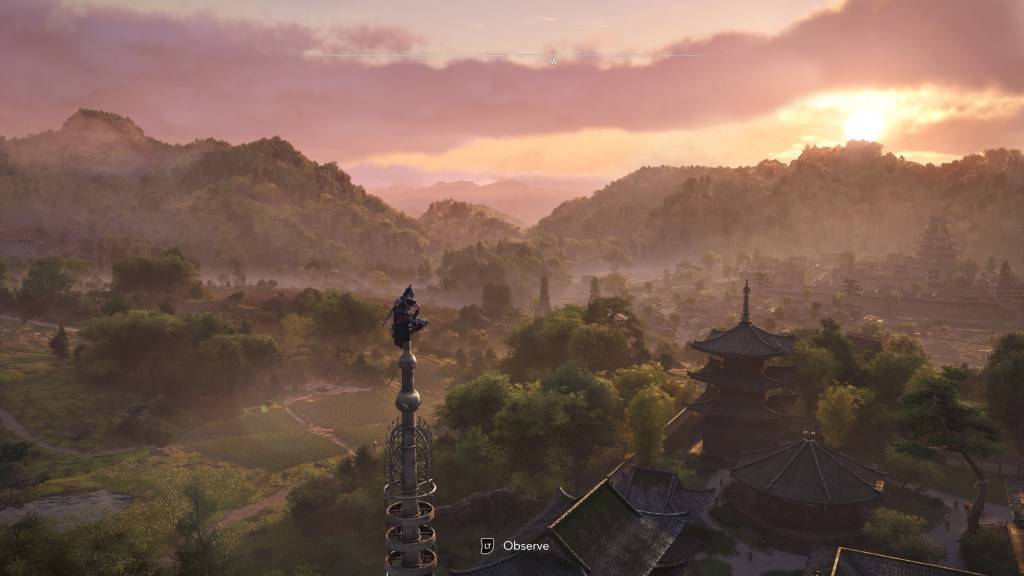
Naoe se prepara para observar un área después de sincronizarse en *Assassin’s Creed Shadows *, a través de Ubisoft

Naoe se prepara para observar un área después de sincronizarse en *Assassin's Creed Shadows *, a través de Ubisoft
Después de obtener acceso al mundo abierto, comenzará en la región de Izumi Settsu, una de las nueve áreas nombradas disponibles en el lanzamiento. Inicialmente, sus misiones y actividades se centrarán en Izumi Settsu antes de expandirse hacia el norte a la provincia de Yamashiro.

Si bien la narrativa del juego puede vincular a Naoe y Yasuke a lugares específicos a veces, puedes aventurarte en otras provincias. Sin embargo, hay dos factores clave a considerar antes de salir corriendo. En primer lugar, las misiones y actividades en otras regiones se desbloquean a medida que avanza a través de la historia, lo que significa que las visitas tempranas pueden no ofrecer mucho que hacer. En segundo lugar, * Assassin's Creed Shadows * incorpora elementos RPG, lo que requiere que los jugadores alcancen ciertos niveles antes de participar efectivamente en el combate en áreas de nivel superior. Estos requisitos de nivel están indicados por un diamante rojo con un número en el mapa, lo que indica que estás bajo niveles y puede tener dificultades para sobrevivir en estas regiones, con algunos enemigos capaces de matar instantáneos.

En resumen, aunque técnicamente puede explorar otras regiones desde el principio, no se recomienda debido a la falta de actividades y posibles dificultades de combate. Para una experiencia más suave y agradable, es mejor seguir la progresión natural del juego.

Artículo anterior:El juego de terror 'Coma 2' presenta una dimensión espeluznante Artículo siguiente:Stephen King, the master of horror and storytelling, is famously known for his belief that you can't truly spoil a good story. He often argues that a great narrative—especially one with strong characters, atmosphere, and emotional depth—can withstand knowing the ending. In fact, he's famously said, "The only real horror is the human heart, and the only thing that can truly spoil a story is a bad ending." But even within that philosophy, he does acknowledge one notable exception. That exception? The "spoiler" that ruins the emotional impact of a twist, particularly one that hinges on irony, revelation, or a character’s tragic realization. King has stated that while most plot twists are "spoilable" in the traditional sense, some spoilers—especially those that reveal a character’s fate in a way that robs the reader of emotional journey—can indeed destroy the power of the story. For instance, in It, he once noted that knowing early on that Pennywise the Dancing Clown is not just a monster but a manifestation of childhood fears and trauma enhances the story. But if you were to learn, say, that a beloved character dies in a way that contradicts everything the reader has come to believe about them—without the buildup, the dread, the mounting tension—then the emotional punch is lost. So, while King generally champions the idea that great stories endure spoilers, he does draw a line: A story can be "spoiled" not by revealing plot points, but by stealing the emotional truth or psychological payoff that makes it powerful. As he puts it in On Writing: "The most powerful moments in storytelling aren't the ones you see coming—they’re the ones that hit you like a freight train because you didn’t see them coming... but when you do see them, and they still hurt? That’s magic." So, to clarify: King doesn’t think you can spoil a good story by revealing plot twists. But he does believe you can ruin a story by revealing the emotional truth too early—especially when that truth is the point of the story. Thus, the "exception" isn't a plot twist—it's the emotional core. And that’s the one spoiler that truly matters.